
From NKAA, Notable Kentucky African Americans Database (main entry)
African Americans and the Bicycle in Kentucky, late 1800s-1940s
By Reinette F. Jones, September 2026This entry has been compiled as a brief overview with an outline of the events and challenges faced by African Americans riding bicycles in Kentucky. The time period is the Progressive Era up to the years just after WWII.
For more than half a century, Kentucky newspapers published the occasional accounts of African American bicycle races. Though, what was most reported were the insults, assaults, accidents, thefts, racial jokes and humor, and the many arrests of African American bicyclists. In addition to the newspaper reports are the names of bicycle racers and repairers enumerated in U.S. Census schedules and those mentioned in city directories and other publications. There are also the names of the African American men who served in the U.S. Army Bicycle Corps in 1897.
At this time, there is not a complete history of African Americans and the bicycle in Kentucky. There has never been a state-wide bicycle association in Kentucky that was exclusively for African Americans. The bicycle organizations were segregated. Membership to the Kentucky Branch of the League of American Wheelmen (L. A. W.) was open to whites only. In 1894, William W. Watts, in Louisville, KY, put forth the motion to make the whites only membership official rather than a practice. The motion passed in 1895 which became the pivotal year of segregation in bicycle racing history at the national and state levels. The segregation continued in Kentucky, such as the races held at the various colored fairs around the state. In Millersburg, KY, a separate bicycle race was held for colored wheelmen in 1895.
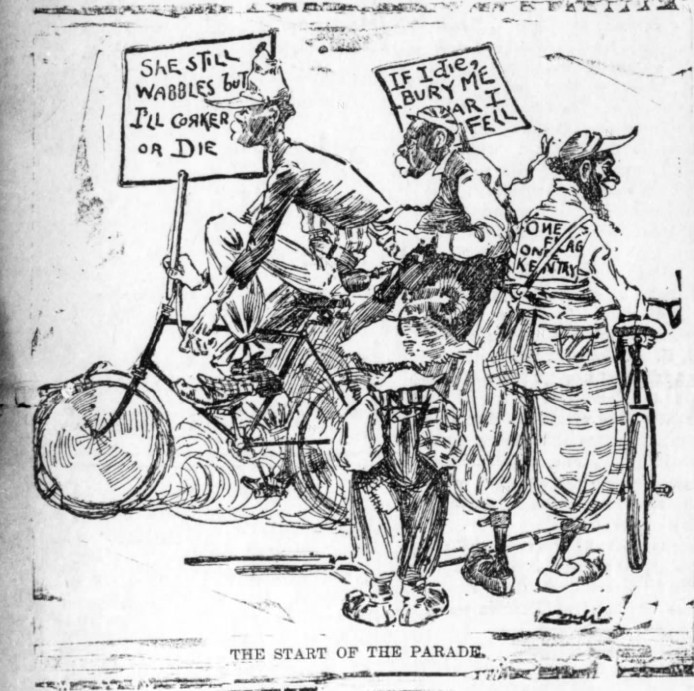
The following year, in 1896, there was a letter to the editor, written in broken English and supposedly from a famous colored racer (bicyclist). The letter was reprinted in several newspapers in the U.S. to inquire if the L. A. W. would be having a bicycle race for colored wheelmen during their next meeting in Louisville, KY. The City of Louisville was planning to form a committee of colored wheelmen to look after the interests and needs of the colored wheelmen who would be allowed to attend the L. A. W. races and the parade, but they would not be allowed to participate in the races. The debate about the rights and wrongs of excluding African American wheelmen from the L. A. W. would continue for decades. In Middlesboro, KY, a bicycle race was held for colored wheelmen only.
The state of Kentucky has never been among the top bicycle manufacturing states or among the top states for the purchase or sale of bicycles. However, there were bicycle manufacturers in Kentucky as early as 1869 when the Allen and Burrows factory in Maysville, KY, built two bicycles that were referred to as "velocipedes." This was the period when bicycles were first manufactured in the United States. In the 1860s, new bicycles cost up to $160 ($6,500 in 2026) and were thought to be much too expensive for the majority of the population.
By 1895, a new bicycle cost $15 to $100 ($600 to $4,000 in 2026). In the 1890s, the average annual salary in the U.S. was $400-$500. The average daily wages for African Americans in the south was 35 cents - 50 cents per day or $128 - $182 per year. The purchase of a new bicycle was still an expensive luxury for Kentuckians, even with a few more bicycle factories in the state. Kentucky bicycle manufacturers included Delker Cycle in Owensboro, KY; Southern Wheel Works in Owensboro, KY; V. C. Razor Cycle Company in Salt Lick, KY; Issac Zimbo, Jr. in Henderson, KY; Lexington Bicycle Works; and Simmons Hardware Company and at least 11 other manufacturers in Louisville, KY.
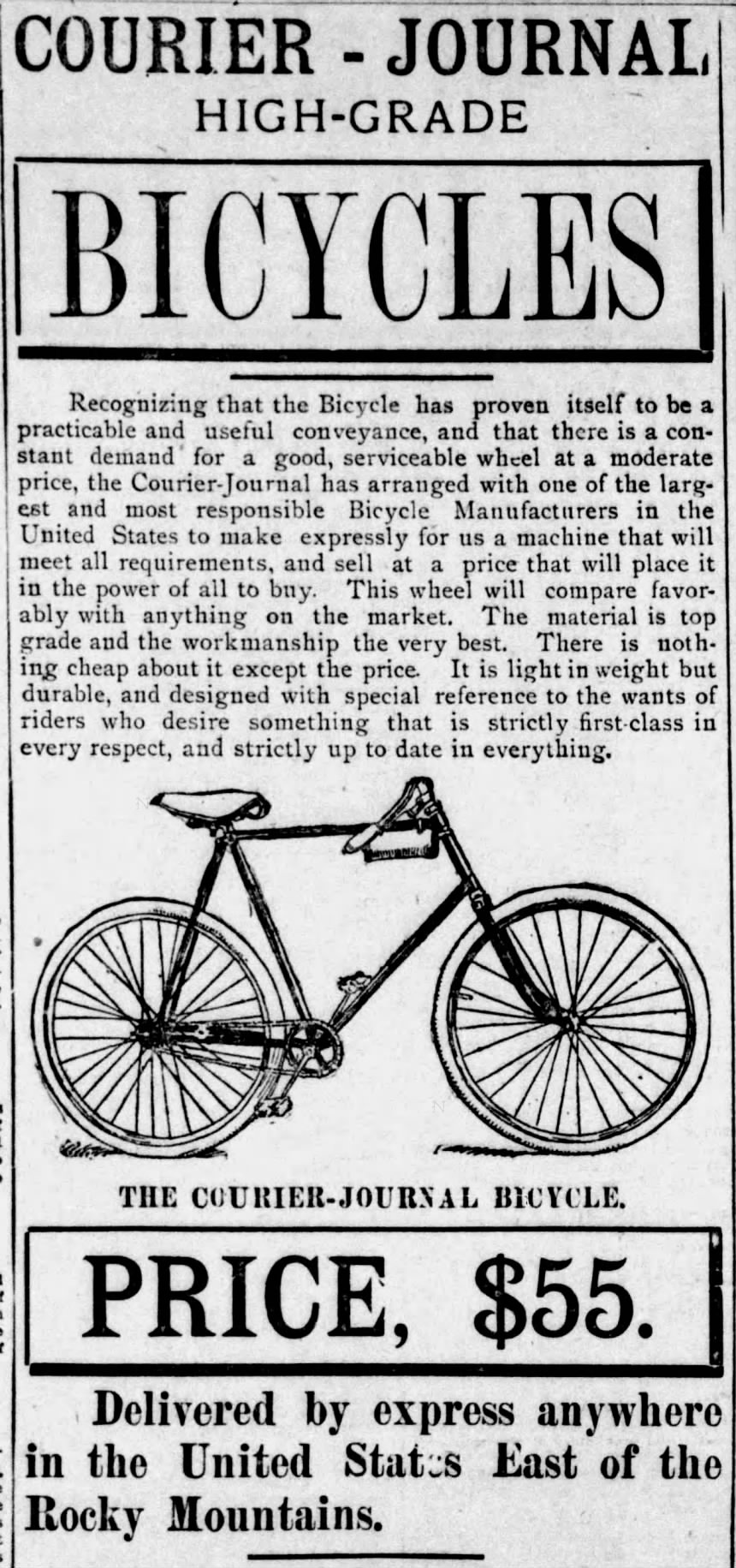
There was also the Courier-Journal Bicycle. In 1891, the name referred to new bicycles purchased by the Courier-Journal newspaper to give as awards to boys who could bring in 100 paid, new 4-week subscriptions. The bicycles were said to be valued at $35 each. There were no African American boys named among the winners. In 1894, the bicycles were available for purchase by newspaper subscribers, and later that year the public could purchase the bicycles. The bicycle for males weighed about 200 pounds and sold for $62, and the bicycle for children and women (with a detachable top bar) weighed about 130 pounds and sold for $48. At the end of 1894, the ads changed to the sale of one bicycle for $55. The Courier-Journal newspaper had contracted with an unnamed bicycle manufacturer to build and ship the Courier-Journal Bicycle to any destination east of the Rocky Mountains. Orders were placed with the Courier-Journal Bicycle Department in Louisville, KY. The 1st Annual Courier-Journal Road Club bicycle race was held in 1895.
[Sources: See "Velocipedes" and "Excitement" in Maysville Bulletin, 04 February 1869, p.3; Wages and Earnings in the United States, 1860-1890. National Bureau of Economic Research (online); The Negro Wage Earner by L. J. Green and C. G. Woodson; The Wheelmen: Bicycle Brands website (online); "Bicycles! For Boys." The Courier-Journal, 18 January 1891, p.9; "Courier-Journal Bicycles." The Courier-Journal, 08 March 1891, p.17; "Owensboro's bicycle factory started up Monday." The Columbia Spectator, 05 September 1895, p.3.; Bicycle advertisement in The Weekly Courier-Journal, 30 April 1894, p.10; The Courier Journal Bicycle advertisement in The Weekly Courier-Journal, 14 January 1895, p.7; "Courier Journal Road Race." The Courier-Journal, 01 September 1896, p.6; and Kentucky city directories, 1890-1900 (Ancestry).]
Louisville and Lexington were thought to have the most bicycles and bicycle clubs in Kentucky. Though little is known about the history of African American bicycle clubs in Kentucky. In 1898, a bicycle race was held in Lexington, KY, for Negro bicyclists only. The newspaper report about the race was published without the contempt that was often expressed in reports about the everyday "colored" and "Negro" bicycle riders. There were definite ideas put into print as to when it was appropriate for African Americans to ride bicycles.
The segregated races for African Americans were presented as acceptable sporting entertainment. The reports of national and international racers such as Major Taylor were hailed as big news, though they too were faced with racial restrictions and prejudice as professional athletes. While the everyday bicycle riders in Kentucky were far too often depicted as reckless, dangerous, and prone to causing injuries to white children, women, and men. These depictions were counter to how the bicycle was marketed as a vehicle for individual mobility, travel, freedom, and care-free touring.
The reveling of the 19th century idea of bicycles being equated with "mobile freedom for all" continues to be repeated in more contemporary publications. Few authors have written about the much broader and bigger history of how local police, the courts, and citizens would restrain the individual mobility, travel, and freedom of African Americans riding bicycles. [See Nathan Cardon. "American cycling has a racism problem." Bunk History via Made by History, 16 November 2021 (online).]
In Kentucky, the newspaper reports about the everyday African American bicycle riders included the following:
- Accusations of sassing or insulting a white person,
- arrests on the charges of being drunk while riding a bicycle,
- news of individuals and groups who chased, beat, and detained African American persons thought to have attempted to steal a bicycle or thought to have stolen a bicycle,
- an African American with a brand-new bicycle suspected of having stolen the bicycle,
- minimizing or disregarding the injuries of African American bicyclists involved in accidents, fights, or an attack,
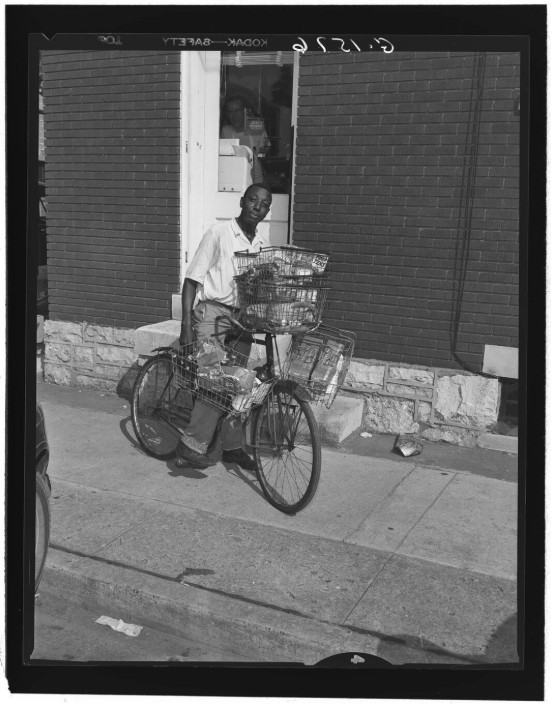
- reports of bootleg liquor being distributed by African Americans using the bicycle for deliveries,
- charges for illegally riding a bicycle on the sidewalk, or riding a bicycle without a light or a bell, or speeding while riding a bicycle, or running a red traffic light,
- accusations of reckless bicycle riding that caused crashes with horse-drawn wagons, horses, motor vehicles, pedestrians, and other bicyclists,
- accusations of intentionally running over helpless white victims with both bicycle wheels,
- drivers absolved of accidents and the deaths of African American bicyclists who were said to have been looking in the wrong direction while turning the bicycle into the path of an oncoming motor vehicle or wagon.
This did not deter African Americans from riding or owning bicycles. Nor did the fact that across the nation the marketing of bicycles was not targeted to African Americans until after WWII. There was a fear as mentioned in the title First Taste of Freedom: a Cultural History of Bicycle Marketing in the United States by Robert J. Turpin, p.54. The thought being that if bicycles were to be marketed to African Americans, "they will do the trade more harm than good by disgusting white prospects."
The U.S. Census Bureau did not collect data on the race of bicycle owners per state. Nor were there local statistics by race on the number of arrests and charges for the violation of state bicycle laws. What is known is that in spite of the challenges, there continued to be African American bicycle owners and repairers in Kentucky. The names of the repairmen can be found in city directories and in the U.S. Census schedules. It is not known to what degree the bicycle repair services were or were not segregated.
The repair services are mentioned here because African American bicycle racers were also employed as bicycle repairmen. In Indiana, this was true of Major Taylor, Woody Headspeth, and Beverly Howard, Jr., all of whom were bicycle racers and repairers in Indianapolis and with ties to Kentucky. Beverly Howard, Jr. was born in Kentucky around 1868 and died in Indianapolis in 1941. He was enumerated in the U.S. Census schedules as a bicycle repairer as early as 1900. Howard's birth year was estimated as 1868 in the 1880 U.S. Census schedule. Others from Kentucky who were bicycle repairers were enumerated as living in cities in Indiana, Alabama, Florida, Ohio, and in Chicago, IL.
There is much more to be said about the full history of African Americans and the bicycle in Kentucky. With continued research there will be new discoveries.
TIMELINE: AFRICAN AMERICANS AND THE BICYCLE IN KENTUCKY. SELECTED HIGHLIGHTS. SOURCES GIVEN BELOW TIMELINE.
1880
Henry Taylor was a colored wheelman (delivery man) for a printing office in Lexington, KY.
1882
On October 25th, the Washington, KY, Colored Fair held its 11th Annual exhibition on the Maysville and Lexington Turnpike in Mason County. An additional attraction was a bicycle race on the 4th day of the event.
1885
Columbus Snell, a colored wheelman, was a prominent performer with Mickens, Buckner, and Anderson Minstrels, a local amateur organization. Snell was also employed as a wheelman for the News and Kentuckian printing offices. In November of 1885, he attempted to hang himself at his brother's home on Pleasant Street in Paris, KY. He was found in time to save his life. Snell had returned from giving a bicycle riding exhibition in Mt. Sterling, KY, and was said to have been distraught over his domestic affair.
1886
In Paris, KY, a racial humor-rumor was attributed to Harry Thomas, the colored wheelman at the Semi-Weekly Bourbon News. The colored people on the west side of town were said to be in an uproar over a mysterious visitor (a ghost) on Walker Avenue.
1890
It was announced in the Courier-Journal that the first national colored bicycle tournament ever given in the world would be held in Brotherhood Park in St. Louis, MO, on June 2. Louisville, KY, was noted as one of the cities with colored bicyclists who would want to compete in the tournament.
1891
The Shelbyville, KY, Colored Fair was held for three days in September. The Friday events included three bicycle races for gold medals by the Louisville Colored Bicycle Club.
1892
It was announced in the Courier-Journal that the admission of Negroes into the L. A. W. (League of American Wheelmen) and into state or division wheelman championships were being "agitated" in northern states where colored wheelmen were becoming plentiful. It was thought that the question of inclusion had not been put forward in Kentucky. "The colored wheelman will not compete soon for the championship of any Southern State."
1893
-The Boyle County Colored Fair was planned to be held August 9th-11th, near Danville, KY, on the Central Kentucky Fair Grounds. Entries were being sought for the horse races and the bicycle race that would be held on the 10th with a winning prize of $25.
-At the end of August, there were two bicycle races held at Versailles, KY, Colored Fair. The Best and Fastest Bicycle Rider on Friday, paid $15 to the winner J. H. Wilkinson. 2nd place winner was Charles Burnham. The Saturday winner, Charles Tyler, was also paid $15. 2nd place winner was T. Dorsey.
1894
William W. Watts, a Louisville lawyer, was a speaker at the 1894 League of American Wheelmen (L. A. W.) Convention held in Louisville, KY. Watts read a letter that supposedly was written by the Union Cycle Club president, Frederick J. Scott, in support of Watts' stand to deny African Americans membership to the L. A. W. Watts, put forth the motion that would limit L. A. W. membership to whites only, making it official rather than a practice. The vote was split 108 for, 101 against, but a two-thirds majority was needed, so the motion was brought forward the following year and it passed.
1895
-Four bicycle races and one foot race were planned for June 4th at the track in Clarence Miller's Park in Millersburg, KY. One of the races would be for colored wheelmen. "Substantial prizes are offered to winners of the races."
-Will Taylor, of Lexington, KY, was thought to be the city's alleged bicycle thief. Several missing bicycles were said to be traceable to him. Taylor was said to have been caught with a bicycle belonging to Dr. S. A. Donaldson.
1896
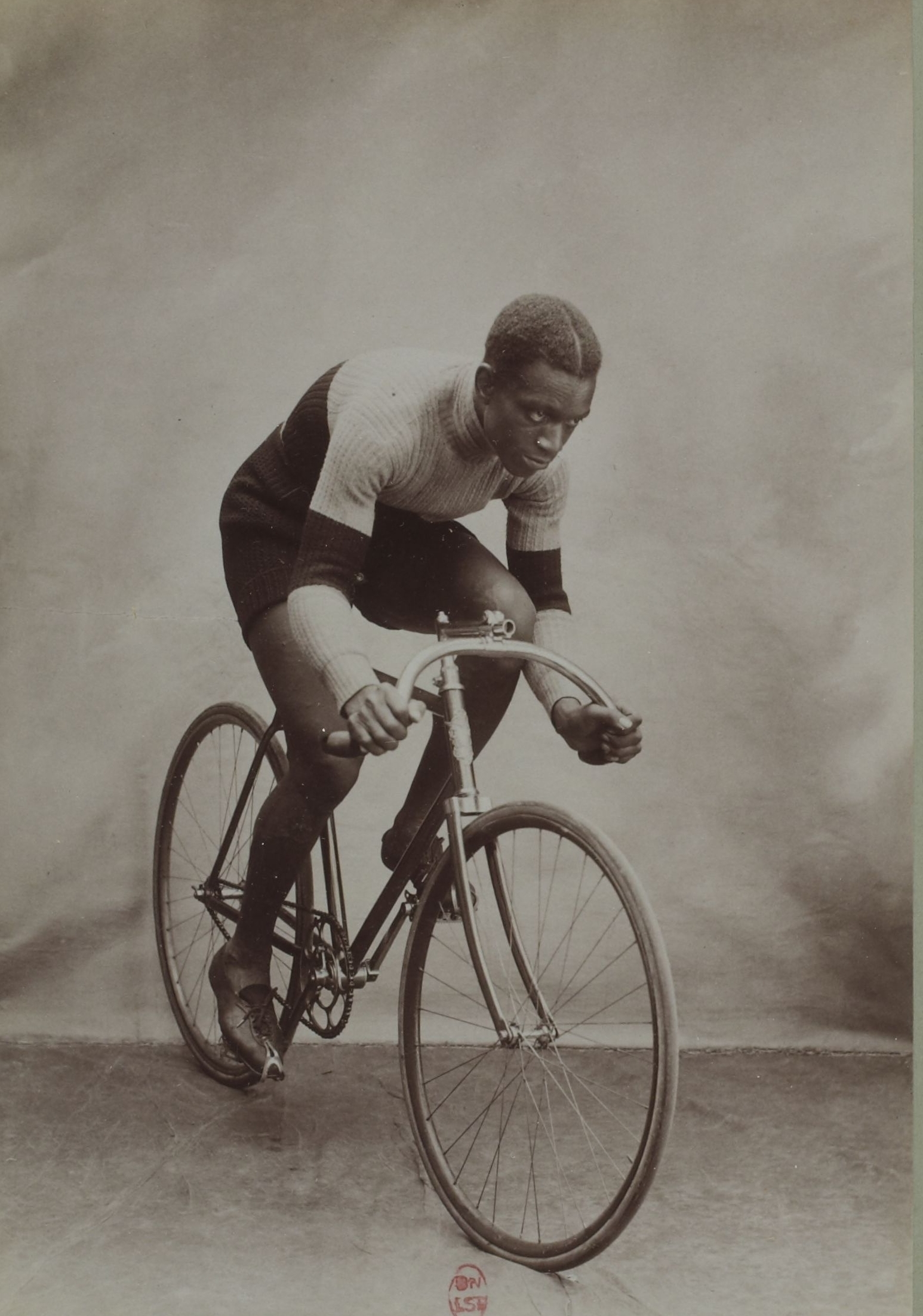
-Marshall Walter Taylor "Major" (1878-1932) became a professional bicycle rider in 1896. Three years later, he was the first African American to win a world championship. He won the one-mile bicycle sprint at the 1899 World Track Championship. Marshall Taylor was an outstanding bicycle racer, he won many races and set many records during his career, 1896-1910. His parents were from Louisville, KY.
-It was reported in the Courier-Journal that after the race line was implemented by the League of American Wheelmen (L. A. W.) in 1895, the organization had the audacity to complain about discrimination during the debate of the Armstrong Baggage Bill that was before a committee of the New York Legislature. A railroad lobbyist declared that the L. A. W. had no right to complain of discrimination, "when it discriminated so ruthlessly and heartlessly against the poor colored wheelman." [Bicycles were determined to be baggage on a train and was therefore subject to the baggage fee.]
-A Negro bicyclist in Lexington, KY, was said to have lost control of his bicycle while riding too fast and ran into a horse hitched to a wagon. After being struck by the bicycle, the horse ran off and was eventually caught. The Negro bicyclist was said to have picked up his damaged bicycle and left the scene of the accident before his injuries could be assessed. It was determined that the wagon was smashed and the horse was bruised.
-The Detroit Free Press published a letter written in broken English, said to have been written by an unnamed famous colored wheelman concerning the L. A. W. meeting to be held in Louisville, KY. The story was repeated in several newspapers. The writer was inquiring if the L. A. W. would be having a colored bicycle race because he wanted to compete in the championship of the United States. And, if colored racers could not join the L. A. W (League of American Wheelmen), then they would form their own league. The writer claimed to know of 25 race riders in Ohio, Illinois, Indiana, and Kentucky who were ready to join the L. A. W.
-The City of Louisville, KY, was planning to form a committee of colored wheelmen to look after the interests and needs of colored wheelmen attending the L. A. W. Meet (League of American Wheelmen) that was to be held in Louisville. There had never been such a committee formed before. Membership to the L. A. W. was restricted to whites only. Colored attendees could view the races and the parade, but they were prohibited from participating in the races. Potential committee members who were bicycle riders were John Palmer, Walter Scott, Alex Wilson, and 2-3 others.
-Six-year-old Frank Meyer, Jr. in Louisville, KY, was knocked down by a Negro wheelman and bruised. The rider left the scene. The rider's additional offenses were riding on the sidewalk and not having a bell.
-In Lawrenceburg, KY, the assistant bookkeeper in the Lawrence[burg] Bank, James Waterfill, was injured when his bicycle collided with the bicycle of a colored wheelman. Both were said to have been riding at a fast pace and neither had a bicycle lantern.
-George Higgins, from Louisville, KY, was arrested by Officer Charles Chapman when he exited a train in Jeffersonville, IN. Higgins had boarded the train with a bag filled with bicycle parts. Train conductor Wilbur Robinson became suspicious when he saw Higgins on the train with the sack, and asked train agent A. H. Schell to notify the police. After Higgins was arrested in Jeffersonville, Superintendent Thomas F. Colbert of the Indianapolis Police Department sent for Higgins to be transported to Indianapolis. Higgins was thought to be the person who assaulted a police officer in Indianapolis then made his getaway on a stolen bicycle before boarding a train.
-The fictional (Negro humor) story of the Thompson Street Colored Bicycle Club was published in the Henderson Daily Gleaner (Henderson, KY). The article was titled "Their Third Parade" and was written by M. Quad, an American humorist journalist whose given name is Charles Bertrand Lewis.
-A second fictional (Negro humor) story by M. Quad [Charles Bertrand Lewis] was published in The Twice-A-Week Gleaner in Henderson, KY. The article was titled "The Bicycle a Boon": the colored bicycle rider and religion.
1897
-A bicycle race was held in Middlesboro, KY, for colored wheelmen. The route was from the post office to the tannery and back. The many bicyclists were said to be lined up from the bicycle track to the depot in Middlesboro. Vienna Rife won the race with a time of 18 minutes, "Bam" was second, and someone named Taylor was third. A. M. Kinnaird & Co. supplied the winning prize of two bicycle hose [air pumps for tires]. Second place prize was a pipe from C. B. Hawes & Co.
-Dave Williams, a colored bicycle rider who was employed at the City Barber Shop in Middlesboro, KY, left to participate in the Danville, KY, Colored Fair bicycle races. He was backed by the colored sporting fraternity.
-Dave Williams, colored champion bicycle rider from Middlesboro, KY, was taken to Lexington, KY, by W. A. Cooke to participate in the Lexington Colored Fair bicycle races.
-Viena [or Vienna] Rife aka Dave Smith, an African American bicyclist from Middlesboro, KY, was a rider at the Lexington Colored Fair. He was said to have won most of the bicycle races until barred from the races to give other cyclist a chance at winning. It was also mentioned in newspapers that Rife had a few run-ins with the law.
-It was reported in the newspaper that there was a one leg and one arm Negro bicycle rider in Bowling Green, KY. The unnamed boy was said to be an expert bicycle rider.
-A colored bicycle party was held at the home of Miss Julia Shores on Chestnut St. in Fayette County, KY. Her home was said to be about two miles outside central Lexington, KY. Those in attendance had ridden bicycles to her home and at the close of the evening at 10:00p.m., they rode back into town and were entertained at the home of Andrew Pays. The party guests included those from Indianapolis, IN, Cincinnati, OH, Dayton, OH, and Paris, KY.
-Charles Gentry, colored wheelman in Louisville, KY, was fined $20 in police court for riding at a reckless rate of speed. A little girl named Mamie Pfeiffer was said to have been "run against" with no injuries when Gentry failed to ring his bicycle bell. The $20 fine was to be a warning to others against reckless riding. [$20 in 1897=$807.00+ in 2026]
-Richard Rout, from Stanford, KY, was one of the 20 soldiers in the USCT Company H, 25th Infantry Bicycle Corps. On June, 14, 1897 the men rode bicycles 1,900 miles from Ft. Missoula, MT, to St. Louis, MO, arriving July 24. They were testing the bicycles as a mode of transportation for troops.
-Travis Bridges from Mt. Sterling, KY, was one of the twenty soldiers in Company H, 25th Infantry Bicycle Corps in 1897. Starting on the 14th of June, the men rode bicycles 1,900 miles from Ft. Missoula, MT to St. Louis, MO, arriving the 24th of July.
1898
-Wheelman Mr. John M'Guirk was out and about and his bruised knee was nearly healed following his collision with a Negro wheelman in Lexington, KY.
-In April of 1898, Louisville, KY, bicyclists Churchill Ghent (colored) and Martin Roarman (white) collided with each other and Roarman was said to have pistol-whipped Ghent.
-A colored wheelman had his front inner tube stolen after parking his bike on Main Street in Danville, KY.
-Guf Jones was a Negro bicyclist in Lexington, KY. In 1898, he organized a bicycle road race for Negro riders only. The event was to take place August 31, starting at the Phoenix Hotel in Lexington at 7:30a.m. and ending in Georgetown, KY. The winning prize was $25.
1899
- The Booker T. Washington Cycle Club at Allen Chapel A. M. E. Church in Louisville, KY, made their first annual appearance on January 25, 1899.
-It was reported in the newspaper that a Negro on a bicycle almost killed a white child in Covington, KY, when he ran into the child. The rider was not captured.
-A colored wheelman was said to have collided with the liveryman Mr. James Glauber in Paducah, KY. The bicycle was demolished. The wheelman was not named.
-Woody Headspeth was considered the "fastest colored rider in the country" except for Major Taylor. He had ridden in the bicycle races held at the Colored Fair in Lexington, KY, where he always finished first. Headspeth's fastest times in 1899 were the mile at 1.493-5 and the two-mile at 3.39 flat with his teammate Jack Robinson.
-Richard Ball was an amateur cyclist from Louisville, KY. He was one of the competing African American cyclists in Kentucky and said to be one of the fastest. He was employed as a waiter at the Galt House Hotel in Louisville.
1900
-E. W. Butler, in Louisville, KY, was a bicycle repairer.
-Charles Chenault was a porter in a bicycle shop in Covington, KY.
-William Cissell, in Louisville, KY, was a bicycle repairer.
-John Dean, in Lexington, KY, was a bicycle repairer.
-John Grover, in Louisville, KY, was a bicycle repairer.
-Davis Jefferson, from Georgia, was a professional bicycle rider who was in jail in Louisville, KY.
-Authur Maxwell, colored performer on a bicycle, was among the entertainers with Oliver Scott's Big Minstrel Carnival that had stopped in Lexington, KY.
-James McGarry, in Louisville, KY, was a bicycle repairer.
-John Munford, in Louisville, KY, was a bicycle repairer.
-Richard Ray, in Louisville, KY, was a porter at a bicycle store.
-Esquire Woodson, in Louisville, KY, was a bicycle repairer.
-A Negro bicyclist was stopped by Officer Bennett in Owensboro, KY, for riding without a lamp. The rider dropped the bike and ran. He was not caught. It was surmised that the Monarch bicycle may have been stolen.
-John Briddle, aka Robert Allen, was arrested and charged with grand larceny when stopped by Louisville, KY, detectives Check, Hickey, and Sexton. The bicycle that Briddle was riding was determined to have been stolen from the home of E. L. Hobbs of Anchorage, KY, based on Detective Sexton's knowledge of Kentucky soils and the mud found on the bicycle that John Briddle was riding.
1901
-It was reported in the newspapers that a white woman in Paducah, KY, was verbally insulted by a Negro man riding a bicycle. It was insinuated that more harm might have come to the woman if she had not cried out into the night which brought several persons to her rescue. The Negro man escaped on his bicycle and was not found by the police who assured the residents that the man was no longer in this region of the country.
-A 16-mile bicycle race for colored riders was held in Lexington, KY. The race was from Newtown Pike to Ironworks Road and around by way of Georgetown Pike to the starting point. The winner was Thomas Hummons with a time of 52 minutes, Thomas Edwards was second, and John Williams was third.
1902
-It was reported in the newspaper that a colored bicyclist ran over a drunk man in Paducah, KY.
-Eddie Goodbar, a colored Cincinnati cyclist, was visiting Lexington, KY, in hopes of entering some bicycle races. He would return to Lexington again in 1904.
-It was reported in the Louisville Courier-Journal that in New York a Negro bicycler named Moses Mimms ran down and injured Miss Elizabeth Klicks. In response, a mob attacked Moses Mimms who was rescued by the police. The mob was said to have reacted as a similar mob might have in any southern city to protect Ango-Saxon women.
1903
-Will Tipton had a bicycle in his possession when he was approached by the Louisville, KY, police at 2:00 a.m. There was a lock on the bicycle and when asked about the key, Tipton supposedly told the police it was none of their business. A scuffle ensued and Tipton got the beat down with a billy club. The bicycle was said to have been stolen from Henry Bois. Tipton was charged with grand larceny.
-It was reported in the newspaper that Earl Bailey, a white boy, was injured by an unnamed Negro bicyclist in Paducah, KY.
-William F. Griffin was a bicycle repairer in Louisville, KY.
-William C. Hale was a bicycle repairer in Louisville, KY.
-Samuel Harris was a bicycle repairer in Louisville, KY.
1904
-It was reported in the newspaper that 5-year-old Mamie Riley may have been fatally injured when she was deliberately run over by Negro bicyclist Ed Campbell in Louisville, KY.
-William F. Griffin was a bicycle repairer in Louisville, KY.
-Henry C. Houston was a bicycle repairer in Louisville, KY.
-William Ragan was a bicycle repairer in Louisville, KY.
1905
-Elliott Walker, colored, said to be the bicycle burglar of Louisville, KY, was arrested in Chicago, IL. Walker was said to have robbed about 40 homes in Louisville during the month of May, including the home Hon. Henry Watterson.
-Lafayette Wall, colored, was in Louisville, KY, when he was struck by an automobile while pumping up his bicycle tire in front of Longaker's Bicycle Store. He was said to not have been badly injured.
- A Negro in Owensboro, KY, attempted to sell J. J. Hill a bicycle. Hill called the police. The man selling the bicycle parked the wheel (bicycle) in the alley and left. The police arrived and took the almost new bicycle to headquarters, it was valued at $25.
-Brutus Dixon, a 14-year-old boy in Henderson, KY, was arrested and lodged in the county jail for grand larceny, the theft of a bicycle. Resident Frank Fivecoat claimed the boy stole the bicycle from him and sold it to M. H. Rosenfield.
-In Louisville, KY, Magistrate Fegenbush dismissed the suit for $50 (damages) brought by colored cyclist Arthur Lauderdale against Isham Bridges. Lauderdale had collided with Bridges' car that was driven by Bridges' colored chauffeur William Curry. Magistrate Fegenbush determined that cyclist Arthur Lauderdale had been racing with another colored cyclist, Dan Currey, when Lauderdale was injured from running into Bridges' car. The case was dismissed due to gross contributory negligence.
-Two bicycle incidents were reported in Paducah, KY. A white boy was knocked down by a Negro bicyclist one day, and the next day a Negro bicyclist collided with an Edgewood Dairy wagon.
1906
-Want ad: WANTED - Colored boy with bicycle. Louisville, KY.
-Orlup Metcalfe, a 10-year-old white boy in Louisville, KY, was said to be seriously injured when he was run over by a Negro bicyclist. The boy was playing in the street with other boys and did not see the bicyclist who, it was said, did not try to avoid running over the boy with both wheels.
-Allen Johnson was a Negro bicyclist who was a waiter at the Palmer Hotel in Paducah, KY. He was badly injured when he attempted to turn out of the path of a delivery wagon from the Famous clothing house. Johnson's bicycle wheels slipped on the freshly sprinkled street and he crashed into the wagon receiving injuries to his face and head. Johnson was pulled from the street by several witnesses who prevented him from being run over by a fire truck rushing to the Rehkof factory. Johnson was carried by buggy to Dr. J. D. Robertson for treatment.
-Colored bicyclist Richard Dorsey collided with pedestrian Joseph Smith in Louisville, KY. The two men got into a fist fight and both were arrested for causing a disturbance. Dorsey said the accident was unavoidable. Smith was released on bond.
-An African American man said to be named Alex Johnson, was chased through Louisville, KY, by bicyclists A. F. Walters and Lawrence Hawkins who was a furniture store owner. Johnson had brought a bicycle to the furniture store to sell to Hawkins who thought that he recognized Johnson and the bicycle as the same one that Johnson had sold to him several months ago. That particular bicycle had been stolen and belonged to George Simpson. It was said that Johnson's second visit to the furniture store included two of his buddies. Hawkins tried to seize Johnson. A. F. Walters, who happened to be in the store, tried to strike Johnson, but his punch missed and Johnson gave a serious bite to Walter's hand. The newspaper report stated that one of Johnson's buddies pulled a gun. Store owner Hawkins then tried to seize Johnson and he too received a serious bite to the hand. The three African American men ran from the shop. Walters and Hawkins were on bicycles pursuing Johnson. All three African American men escaped. Furniture store owner Hawkins was left with the bicycle that the person said to be named Johnson had brought to his store.
-John Dean, in Lexington, KY, was a bicycle repairman.
-John Hawkins, 15 years old, and Oscar Baker, 13 years old, both Negroes were arrested by the Covington, KY, police for being members of a bicycle stealing gang. While in police custody, the boys said they had no knowledge of stolen bicycles, but after continued interrogation, both were said to have confessed and led police to three stolen bicycles. Hawkins was held in jail overnight and Baker, due to his age, was released to his father. In Juvenile Court the next morning, Hawkins admitted to stealing one bicycle and was sentenced to 6 years in the state reform school. Baker's father did not bring him to court and the police were looking for him.
-Charles Burnam, a bicycle repairer from Richmond, KY, built a miniature steam engine train for the exhibit at the Lexington Colored Fair.
1908
-When Louisville, KY, bicycle dealer Phillip Lipski arrived at this shop, there was a Negro man who wanted to sell a bicycle. Lipski became suspicious and was said to have recognized the bicycle as stolen. A store clerk was told to hold the Negro man while Lipski called the police. The clerk was unable to maintain a hold on the man who attempted to get out the front door that had been locked. Lipski said that he hit the man twice with a baseball bat but the man did not succumb to the blows. The man made his way to the second floor where he climbed out onto the roof and escaped when he jumped to the ground. The man was said to have had no serious injuries, according to the newspaper.
-In was reported in the newspaper that Mr. Joseph Viehl was crossing the street at an intersection in Danville, KY, when a Negro bicyclist ran into him. Viehl was knocked down and bruised. "There is a town ordinance regulating bicycle riding in the city limits and it should be enforced against all offenders, white and black."
-William M. Ragen, in Louisville, KY, was a bicycle repairman.
1909
Willie Schaffer, a 17-year-old drug store clerk in Paducah, KY, was given a revolver and the task of hunting down a bicycle thief who was suspected of being the Negro man who was said to have been hanging around the store. The bicycle belonged to a Mr. Ellis. Shaffer spotted a Negro man on a bicycle then positioned himself in the middle of an intersection with the gun drawn and demanded that the man turn over the bicycle. The man claimed to have bought the bicycle from someone for 25 cents. The retrieved bike was turned over to Mr. Ellis.
1910
-Louis Baughman, in Louisville, KY, was a repairer in his bicycle shop.
-Fox Carson, colored, from Crab Orchard, KY, was arrested in Lancaster, KY, and brought to Danville, KY, where he was jailed on the charge of grand larceny. Carson was said to have stolen a bicycle from Mr. Harvey Miller several months prior to his arrest. Carson would remain in the Danville jail for two months until the January term of the Boyle County Circuit Court.
1911
-Charles Garner, a Negro from Lexington, KY, was arrested in Nicholasville, KY, for having stolen a bicycle from McClure & Co. Nicholasville police brought Garner and the bicycle to Lexington and Garner was jailed. McClure & Co. refused to press charges against Garner and he was released. The Lexington police protested the release of Garner and warned that letting him go without prosecution was encouraging the continued epidemic of bicycle stealing that had been prevalent in Lexington for some time.
-George Bailey, a Negro, was thought to be a long-term bicycle thief in Paducah, KY. He was charged and found guilty on two counts of grand larceny. Bailey was expected to serve one to five years in prison and a second term for obtaining money on false pretenses.
1914
Want ad: WANTED - Colored boy with bicycle. Louisville, KY.
1916
What was thought to be a humorous story was reported in the Louisville Herald that a car backfired in Louisville, KY, and a nameless Negro bicyclist fell to the ground and took cover.
1918
-George W. Brown (colored) was a wheelman (deliveryman) at Carrell-Rogers Co. in Louisville, KY.
-In Paducah, KY, Mrs. H. W. Barbee was said to have been seriously injured and knocked unconscious when she was run down by one of the three Negro women who were speeding on their bicycles. Mrs. Barbee was carried to her home by passersby where she was attended by a doctor.
-Louisville, KY, store owner, Herman Neubeck, was shot in the face by a boy bandit wearing a handkerchief mask. The gunman lost his hat as he was fleeing from the store. Inside the hat was the name B. Turner. Neubeck and other witnesses were sure the shooter was probably a Negro who had ridden a bicycle to the store.
-William M. Winston was a bicycle repairer in Louisville, KY.
1919
At the age of 75, Harvey Banks was referred to in the newspaper as an expert Negro bicycle rider in Manchester, OH. Banks was born in Mayslick, KY, where he was enslaved to Benjamin Omstead. Banks was a Civil War veteran, and later moved to Manchester, OH, where he bought his home in 1884.
1920
-Clarence Brown, in Louisville, KY, was a mechanic in a bicycle shop.
-Edward Raglin, in Louisville, KY, was a repair man at a bicycle shop.
-George Logan, in Louisville, KY, was a bicycle repairer at a shop.
1922
-Creighton Hayden, a Negro boy, was called before Judge Watkins in the Owensboro, KY, City Court for the charge of stealing a bicycle. A group of boys had seen Hayden on the bicycle that they said belonged to the son of Joe Davis. The group of boys chased Hayden to his home in Tin Cup Alley and held him until the police arrived and placed him under arrest.
-Two grocery store delivery boys collided on their bicycles in Mayfield, KY. The newspaper concluded that both boys were at fault. George Sherrill, Negro, was employed at Berry Rule Grocery. Sammie Cope, white, was employed at R. D. Robinson Grocery.
1923
-In Paducah, KY, Son Stubblefield, a Negro, was sentenced to three years in the Eddyville, KY, prison for the theft of a bicycle (grand larceny). The bicycle belonged to Robert Phillips, Jr.
-Ester Collier, Negro bicyclist, was charged $1 and full cost in the Lexington, KY, Police Court for riding her bicycle on the sidewalk.
-Delman Rates, Negro bicyclist, was to appear in the Owensboro, KY, Police Court for the charge of riding his bicycle on the sidewalk.
-Mrs. Anna McDowell was struck and knocked down by a Negro bicyclist in Louisville, KY. Mrs. McDowell was taken to the hospital, then removed to her home. The Negro bicyclist left the scene. His description was given to the police.
1924
Harry Broadus, Negro bicyclist, was charged $5 in the Lexington, KY, Police Court for riding his bicycle on the sidewalk.
1926
At the 4th of July events held in Middlesboro, KY, among the bicycle races was a race for all colored riders. 1st place prize was $2.00, second place $1.00.
1930
-Negro bicyclist was charged in the Lexington, KY, Police Court with riding his bicycle without any lights. His case was continued generally. Negro bicyclist Charles Gordon was charged $1 for the same offense.
-Stanley McPheeter, Negro bicyclist, was charged in the Lexington, KY, Police Court with riding his bicycle without lights. His case was transferred to county court.
-Henry Thomas, Negro bicyclist, was fined $1 in Lexington, KY, Police Court for riding his bicycle without any lights.
-Samuel E. Clark was a truck driver for a bicycle shop in Louisville, KY.
-George Logan, in Louisville, KY, was a bicycle repairer.
-James W. Moore was a chauffeur for a bicycle shop in Louisville, KY.
-Ed Ragland, in Louisville, KY, was a bicycle repairman.
-Sam T. Thomas worked at a bicycle store in Louisville, KY.
-Owen Traube, a Negro bicyclist, died in Louisville, KY, after colliding with a car driven by George Effinger who was arrested and charged with manslaughter. Effinger was released on a $500 bond.
1931
-Reuben Talbert, Negro bicyclist, was charged $1 in Lexington, KY, Police Court for riding his bicycle without any lights.
1935
Charges of delinquency and failure to make a boulevard stop were leveled against 14-year-old Negro bicyclist Charles Kaufman in Louisville, KY. Kaufman had collided with the Warisse Baking Company truck driven by William Langley who was charged with operating a vehicle without a chauffeur's license.
1936
-Negro bicyclist, Charles Murphy, was fatally injured in Louisville, KY, when he was crushed between a truck and a car. He died on the way to the hospital. Murphy had been hanging onto a truck with one hand and guiding his bicycle with the other hand. The truck driver George Smith was charged with manslaughter. Smith was driving the Bates Motor Transportation Lines truck.
-Fred Caulder, Negro bicyclist, had a dismissed charge in the Lexington, KY, Police Court for riding his bicycle on the sidewalk.
1937
-Negro bicyclist, Charles Norris, was charged with reckless driving in Louisville, KY. Norris was said to be zig-zagging in traffic.
-Negro bicyclist, Charles Martin, was charged with reckless driving in Louisville, KY. Martin was said to be making figure 8s and fancy patterns while his head was bent low over the handlebars and driving on the opposite side of the street, all while searching for a screw that had fallen from his bicycle brake. Martin was arrested by Detective Sergeant Charles Doyle of the homicide squad.
-Five Negro bicyclist were arrested for operating their bicycles without lights, and were to appear in the Lexington, KY, Police Court. The arrests were said to be part of the police effort to prevent accidents. The five men were Wilford Dining, Robert Tribble, Sanford Vinegar, Clarence Sidney, and Roy Jones.
-George Moore, Negro bicyclist was charged $1 by the Lexington, KY, Police Court for riding a bicycle with no lights.
1938
-In Louisville, KY, Patrolman Robert F. Buckley was fined a day's pay for arresting Negro bicyclist, 18-year-old Thomas Keith, without cause. Keith had struck Buckley's car door when Mrs. Buckley opened the door as Keith was riding past on his bicycle in the proper lane.
-Negro bicyclist Arthur Johnson was arrested for public drunkenness in Louisville, KY. He was said to have fallen into the street four times before the arrest.
-Want ad: WANTED - Colored boy with bicycle. Lexington, KY.
1939
-Colored bicyclist Smith Wimsatt was seriously injured when his bicycle collided with a city bus in Owensboro, KY. Wimsatt was said to have pulled out into the path of the bus. Snow and slippery streets were blamed for the accident.
-Negro cyclist George McDonald was arrested for public drunkenness in Louisville, KY, when he fell off his bicycle twice and almost ran into a police cruiser.
-Negro bicyclist James Young Hawkins was killed when his bicycle collided with a car driven by Mrs. James Southard in Madisonville, KY. Mrs. Southard was "absolved from blame" by the coroner's jury. The deceased was said to have been at fault because he was looking north while making a turn south.
1940
-George Logan, in Louisville, KY, was a bicycle repairer.
-Ray Crompler was the winner of the bicycle race for colored boys. The prize was $1.00. The race was held for colored boys 14 and younger. it was one of the events at the Whitesburg, KY, Labor Day Celebration.
1942
-John Ray, Negro bicyclist, was fined $1 and costs in Lexington, KY, Police Court for not having a light on his bicycle.
-Julian Jackson and Isaac Jones, Negro bicyclists, were each fined $1 in Lexington, KY, Police Court for not having lights on their bicycles.
-Brown Harold Fisher, Negro bicyclist, fined $1 in Lexington, KY, Police Court for operating a bicycle without a light.
-Carl Burrell was fined $5 in Lexington, KY, Police Court for running a red light while riding his bicycle.
1943
In Earlington, KY, Robert Lee White, colored, was said to have been injured when he ran into a car driven by Elgin Boze. Though the headline said the child was hit by the car. The accident was said to have happened because Robert L. White was looking at a car coming from the opposite direction when he ran into the Boze car. White was said to have been treated for minor injuries.
1946
-Alexander Wilson (1925-1977), from Pembroke, KY, was a bicycle repairman in Hopkinsville, KY, when he enlisted in the U.S. Army during WWII.
-Sylvester Boyd, a Negro bicyclist in Owensboro, KY, was hit by a car driven by Joseph Darrell Tong. Boyd was taken to the hospital and Tong was charged with reckless driving and summoned to appear in police court.
1948
-Jasper McDavitt Cotton (1928-1983), in Bardstown, KY, was a laborer in a bicycle repair shop when he enlisted in the U.S. Navy.
-At the Graves County Fair in Mayfield, KY, a variety of races were held that were open to citizens of Mayfield and Graves County. There was a bicycle race (For Colored Riders) with prizes of $5, $4, $3, $2, $1.
1949
The Hoptown Fair in Hopkinsville, KY, was open to all colored people. The fair committee had also set aside August 8th for the colored people and their events. The committee recognized August 8th as a holiday among the colored people: Emancipation Day. Among the competitions on August 8th were horse, mule, and bicycle races.
SOURCES:
Bicycle: the history by David V. Herlihy; 1880 U.S. Census Schedules (Ancestry); see William W. Watts in Ethnicity, Sport, Identity, edited by J. A. Mangan and A. Ritchie, p.20; "Washington Colored Fair." The New Maysville Republican, 21 October 1882, p.3; "He was depressed in spirits." The Cincinnati Enquirer, 18 November 1885, p.5; "A Small Ghost Story." Semi-Weekly Bourbon News, 02 February 1886, front page; "The First national bicycle tournament." The Courier-Journal, New Series, Second Part, 25 May 1890, [p.13]; The colored fair will commence today." The Shelby Weekly News, 02 September 1891, p.6; "Bits of news for the men who ride steeds of steel." The Courier-Journal, 03 July 1892, p.13; "The Boyle Co'ty Colored Fair." The Tri-Weekly Kentucky Advocate (Danville, KY), 25 May 1893, p.2; "The Colored Fair." The Woodford Sun, 31 August 1893, p.5.
"Millersburg." The Bourbon News, 31 May 1895, p.4: "Alleged Bicycle-Thief." The Kentucky Post, 08 October 1895, p.2; "Wheels. ... Louisville will, in all probability, have one committee ..." The Courier-Journal, 01 March 1896, p.9; "For the first time since the color line was drawn ..." The Courier-Journal, 12 April 1896, section 2, p.7; "Ran into a horse." The Leader, 15 May 1896, p.8; "The Queen's English." The Detroit Free Press, 19 June 1896, p.4; "Wheelman runs over a child." The Courier-Journal, 11 July 1896, p.8; "Bicycle Collision." Kentucky Advocate (Danville), 04 September 1896, front page; "Harrison. Other Indiana News. Jeffersonville." The Courier-Journal, 15 October 1896, p.7; M. Quad. "Their Third Parade: Colored cyclists make a five mile century run." Henderson Daily Gleaner, 03 November 1896, p.6; "The Bicycle a Boon." Twice-A-Week Gleaner, 06 November 1896, p.7; Who was Major Taylor? at the Major Taylor Association, Inc. website.
"The colored wheelmen of this city ..." Middlesboro News, 07 August 1897, p.4; See Dave Williams in "Base Ball and Bicycle Notes." Middlesboro News, 28 August 1897, p.3; See "Dave Williams ..." The Weekly Herald, 10 September 1897, p.5; "Colored Bicycle Party." The Daily Leader, 13 September 1897, p.2; See Viena Rife in Middlesboro News, 18 September 1897, p.4; "Kentucky State News: Bowling Green has ..." The Winchester Democrat, 07 September 1897, front page; "Colored Wheelman Fined." The Courier-Journal, 13 November 1897, p.7; "Mr. John M'Guirk ..." The Morning Herald, 07 April 1898, p.2; "Greek meets Greek." The Courier-Journal, 19 April 1898, p.8; "Smooth Thief." The Tri-Weekly Kentucky Advocate, 01 July 1898, p.3; "A Road Race." The Sunday Leader, 14 August 1898, p.2; see Booker T. Washington Cycle Club in "Personal Mention," Recorder, 07 January 1899, p. 4; "Run down by cyclist. The Kentucky Post, 18 September 1899, front page; "A colored wheelman ..." The Paducah Sun, 27 September 1899, p.4.
See bicycle repairers in the 1900 U.S. Census Schedules (Ancestry); see Beverly Howard, Jr. in Paul Mullins "Cycling and racism in early 20th century Indianapolis" at InvisibleIndiapolis.Wordpress.com (online); see Beverly Howard's Indiana Certificate of Death, Registered No.16035 (Ancestry.com); "A Negro riding down Main Street ..." The Messenger (Owensboro, KY), 25 March 1900, p.8; "John Briddle, alias Robert Allen ..." The Courier-Journal, 13 October 1900, p.12; "Vienna Rife, better known as Dave Smith." Middlesborough News, 27 October 1900, p.3; "Ugly Deed." The Sunday Visitor, 14 April 1901, front page; "City and Vicinity." Lexington Leader, 05 July 1901, p.8; "Run down by bicyclist." The Paducah Sun, 12 May 1902, p.10; "Eddie Goodbar ..." Lexington Leader, 09 September 1902, p.5; "Everywhere the Same." The Courier-Journal, 29 October 1902, p.4; "Stole a Bike." The Courier-Journal, 12 June 1903, p.7; "Earl Bailey ..." The Paducah Sun, 14 July 1903, p.4; see Samuel Harris on pp. 568 & 1662, William F. Griffin on p.531, and William C. Hale on p.547, all in the Louisville City Directory, 1903; "Brutal deed." The Courier-Journal, 21 June 1904, p.4; see William Ragan on p.1095, William F. Griffin on p.556, and Henry C. Houston on p.668 in Caron's Directory of the City of Louisville for 1904; "Louisville Burglar." Owensboro Daily Inquirer, 19 June 1905, p.8; "Colored cyclist is struck by automobile." The Louisville Herald, 08 July 1905, p.7; "Negro bicycle thief in clutches of law." Henderson Daily Gleaner, 19 August 1905, p.8; "Suit Dismissed." The Courier-Journal, 30 August 1905, p.10; "Another bicycle accident." The Paducah Sun, 05 October 1905, front page.
"Want ad. WANTED - Colored boy with bicycle." The Courier-Journal, 04 January 1906, p.7; "Child seriously hurt by Negro on bicycle." The Courier-Journal, 11 April 1906, p.12; "Just in Time. Negro bicycle rider close to death in collision." The Daily News=Democrat, 02 June 1906, front page; "Negro on bicycle collides with pedestrian." The Courier-Journal, 03 June 1906, p.12; "Exciting chase after Negro bicycle thief." The Courier-Journal, 11 August 1906, p.6; "Negro thieves taken in by police." The Kentucky Post, 18 August 1906, p.2; see Charles Burnam in "Banner Gathering" Lexington Leader, 14 September 1906, p.8; "Negro bicycle thief, big stick proof, eludes suspicious prospective buyer." The Courier-Journal, 22 January 1908, p.7; "Painfully Bruised." Kentucky Advocate (Danville, KY), 15 October 1908, p.4; see William M. Ragen in Caron's Directory of the City of Louisville for 1908, p.1194; "Unruly Negro...Negro bicycle thief attempts to sell wheel, but escapes when officers are called." The Owensboro Daily Messenger (Owensboro, KY), 18 March 1909, p.6; "Sherlock Holmes...Willie Shaffer recovers wheel, using revolver at proper dramatic climax." The Paducah Evening Sun, 08 September 1909, p.6; see Louis Baughman in 1910 U.S. Census schedule; "Thief Caught." Daily Kentucky Advocate (Danville, KY), 04 November 1910, front page.
"Negro steals wheel but is released." The Lexington Herald, 13 June 1911, p.12; "Auto backfires; "George Bailey ..." The News=Democrat, 27 September 1911, front page; Negro on wheel collapses." Louisville Herald, 15 December 1916, p.3; see George W. Brown on p.239 in Caron's Directory of the City of Louisville for 1918; "Negro women bicycles strike woman, injure." The Paducah Evening Sun, 24 June 1918, p.4; "Merchant shot by boy bandit." The Courier-Journal, 19 August 1918, front page; see William M. Winston on p.1566 in Caron's Directory of the City of Louisville for 1918; "Aged Negro is an expert bicycle rider." The Maysville Public Ledger, 18 July 1919, p.4; see Clarence Brown, Edward Raglin, and George Logan in 1920 U.S. Census schedule; "Negro had bicycle." Owensboro Inquirer, 23 March 1922, p.8; "Sammie Cope ..." The Daily Messenger (Mayfield, KY), 29 November 1922, front page; "City court adjourns out of respect to Police Judge Riley." The Lexington Leader, 12 June 1913, p.10; "Want ad. WANTED - Colored boy with bicycle." The Louisville Times, 21 April 1914, p.14; "Negro bicycle thief must serve time." The News-Democrat, 13 January 1923, p.2; "News of the Courts: In Police Court." The Owensboro Messenger, 13 June 1923, p.3; "Woman knocked down by Negro on bicycle." The Louisville Herald, 30 September 1923; "In Police Court." The Lexington Herald, 12 March 1924, p.5; "Program 4th of July Celebration." Middlesboro Daily News, 26 June 1926, p.4.
"Police Court." The Lexington Leader, 10 January 1930, p.23; "Police Court." The Lexington Leader, 14 January 1930, p.23; "Police Court." The Lexington Leader, 16 January 1930, p.2; 1930 U.S. Census schedule (Ancestry); "Negro on wheel dies in crash." The Courier-Journal, 01 May 1930, p.16; "Police Court." The Lexington Leader, 26 May 1931, p.16; "Police Release Boy." The Courier-Journal, 14 August 1935, p.22; "Negro cyclist crushed to death between cars." The Courier-Journal, 26 August 1936, p.10; "Police Court." The Lexington Leader, 18 September 1936, p.7.
"Bicycle rider, hunting screw off wheel, faces traffic charge." The Courier-Journal, 05 September 1937, p.13; see Charles Norris in "Marks on Finder." The Courier-Journal, 05 September 1937, p.4; "Five bicyclists held for riding without lights." The Lexington Herald, 16 November 1937, front page; "Police Court." The Lexington Leader, 02 December 1937, p.19; "Policeman is fined for unjustified arrest." The Courier-Journal, 26 January 1938, p.8; "Negro arrested as drunken cyclist." The Courier-Journal, 04 October 1938, p.3: "Want ad. WANTED - Colored boy with bicycle." The Lexington Leader, 09 November 1938, p.16; Negro bicyclist seriously hurt." The Owensboro Inquirer, 03 February 1939, front page; see George McDonald in "Traffic accidents kill two men and a woman." The Courier-Journal, 10 April 1939, p.20; "Motors figure in two deaths over weekend." Madisonville Messenger, 03 July 1939, front page; 1940 U.S. Census Schedule (Ancestry); "Local No.6800 thanks supporters." The Mountain Eagle, 05 September 1940, front page.
"Police Court." The Lexington Leader, 24 July 1942, p.9; "Police Court." The Lexington Leader, 29 July 1942, p.11; "Police Court." The Lexington Leader, 08 September 1942, p.9; "Colored bicyclist hit by auto." The Earlington News, 20 August 1943, front page; Alexander Wilson's WWII Army Enlistment Record, 1946 (Ancestry); "Negro 'cyclist hurt when struck by car." The Owensboro Messenger, 03 November 1946, p.2B; see Jasper McDavitt Cotton in Korean War Draft Record Cards in Ancestry.com; "Announce prizes in Graves County race program at fair." The Mayfield Messenger, 19 August 1948, front page; "Plans made for annual Hoptown Fair." The Todd County Standard, 14 July 1949, front page.
ADDTIONAL SOURCES:
Jesus M. Barajas. "Not all crashes are created equal: associations between the built environment and disparities in bicycle collisions."